Friday, January 28, 2022

Film Club Featurette: Cache (2005)


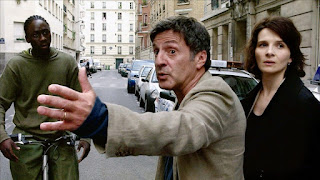
On Wednesday, 2 February at 18:31 the Phnom Penh Film Club selection will be Michael Haneke’s tantalizing and intensely provocative psychological thriller from 2005, *Cache*, starring Daniel Auteuil and Juliette Binoche. 
.
Since his breakthrough with 1997’s home-invasion arabesque *Funny Games*, Michael Haneke has continually distinguished himself as a director whose facility for nurturing audience discomfiture is surpassed only by his virtuoso flair for transgressive social comment. Every Haneke film presents us with the voyeuristic charge of seeing comfortable arrangements kicked specactularly over, and every Haneke film conceals within that story a deeply unnerving suggestion of our own tawdry contradictions and conceits. We are each the mark in a long-con spun from our own silly mythologies; we are each the victim of our self-inflicted torment and abuse. 
.
Every Haneke film wraps these themes in different packaging, from the strained security of modern teacher-student power structures, to the distinctly bourgeois unease of having strangers outstay their welcome in our home. But with Cache, Haneke unquestionably attains the apotheosis of his chosen form—an essay on privilege, disempowerment and marital strife that manages to end up an indictment of post-colonial denial by the French upper middle class. And all of it hiding in the plain sight of a low-current, conspicuously unhurried suspense narrative about a journalist whose worst enemy finds ever-more-clever devices for heralding his resentment without revealing his identity, whereabouts or motive. 
.
After the intensely stimulating Funny Games, after the quieter and much more subversive *Code Unknown* (2000), and particularly after the skin-crawling psycho-sexual pathos of *The Piano Teacher* (2001), Haneke’s credential as both a maestro of directorial suspense and a critically important voice of social contrarianism would never again come in doubt. With Cache, however, he has achieved something even more impressive: a film whose cinematic entertainment value feints us all into a suggestible vulnerability far more personal, and thus far more affecting when our own Faustian bargains and comfy hypocrisies are finally revealed as the whole point all-along. 
.
I hope everyone can join us on Wednesday evening at 18:31 for this taut and meticulously enthralling tapestry of misdirection and deceit. I can’t always make this assertion, but in the present case I can solemnly attest that no one who comes to see this one for the first time will soon forget it.

Click Here to Read More...

Tuesday, January 25, 2022

Film Review -- The Thin Red Line

Our second Sunday-night-war-movie in a row (I promise you this wasn’t intended) is this Sunday evening’s 18:31 screening of *The Thin Red Line*—Terrance Malick’s sprawling adaptation of the James Jones novelization of the Battle of Guadalcanal. 
.
Between 1973 and 1995, the famously mercurial and reclusive cinematic genius Terrance Malick had made exactly two motion pictures: the bloody and sociopathic crime-spree picture *Badlands* in 1973, and 1978’s dreamy rural-American obituary *Days of Heaven*. Both were enormously successful (both critically and commercially) and together they engendered an almost cult-like Hollywood fascination with the mystique of the man and his ongoing creative intentions. Nobody knew when the next Terrance Malick film might get made—if ever—but everyone was sure that if and when it ever happened, they wanted in.   
.
Thus it was that word came down of pre-production on a new Malick film, the relevant casting office was veritably inundated with A-list acting talent hoping to secure even a few lines. “Just give me a dollar and tell me where to show up,” Sean Penn famously told Malick, before learning that he had in fact been cast for one of the film’s three principal roles. Copies of script segments were circulated to everyone from Robert De Niro to Brad Pitt to Al Pacino to Bruce Willis. Martin Sheen, Kevin Costner and Ed Norton all also expressed interest. Gary Oldman offered to do the picture for free and Bruce Willis offered to pay the airfares of the entire casting team in return for a chance to read. 
.
Obviously this kind of interest would pretty-much guarantee that the cast ultimately chosen could carry just about any movie, but Malick’s embarrassment of surplus talent didn’t stop with the acting: He also enjoyed the contributions of such behind-the-lens creative titans as Hans Zimmer for the soundtrack and the great John Toll for the principal photography. All that remained now was for Malick to leverage these advantages to a genuinely superlative picture, thus fulfilling the promise of both his all-star team and the expectations of his own legacy. Not as easy it may sound, especially given the curious fit between Malick’s particular style on the one hand, and the particular demands of making a successful war epic on the other.
.
It’s difficult to suggest that a director with exactly two movies to his credit at the time should be thought of as an auteur, but if anyone could justify the moniker with such a short resume it’s Terrance Malick. Faced with the cardinal choice of a tonal break or a true-to-self adaptation, Malick unflinchingly favoured his own predisposition for long, atmospheric takes and wistful narrative pacing, rather than subordinating those impulses to a back seat for the slam-bang subject matter of one of the loudest and bloodiest engagements of the Second World War.  
.
Even before he’d finished the book Malick saw his opening for reconciling those two demands in the structure of the basic story: Rather than a Spielberg-like inciting incident of high-explosive mayhem, Malick opens our chronicle with a long take of a deserter enjoying minimalist island life among the indigenous peoples of the Solomons. 
.
From there the messy business of meting punishments and taking hills is never far from the film’s agenda, but that business never seizes the initiative at the expense of a much deeper dive into the psyches and motivations of a cavalcade of flawed and limping soldiers, either. We come to the thing expecting “Saving Private Ryan But With Palm Trees,” and what we get instead is “Badlands But With Rice”—to our abiding self-chagrin for having not seen it coming, but also to our immense gratification all the same. 
Critically speaking The Thin Red Line earned high marks across the board and even a few objective superlatives. It was nominated for seven Academy Awards including Best Picture, Best Director, Best Cinematography and Best Soundtrack. In 1999 it won the Golden Bear for best picture at the Berlin International Film Festival. Martin Scorsese ranked it as his second-favorite film of the 1990s and Gene Siskel called it "the greatest contemporary war film I've yet seen."
.
I hope everyone will plan to join us on Sunday evening at 18:31 for this dense and gorgeous tapestry of stunning performances and even more arresting compositions. Few pictures we’ve tried have been anything like as challenging, and few have been anything like as worth the effort. 

Click Here to Read More...

Sunday, January 23, 2022

Film Club Featurette: City of God (2002)


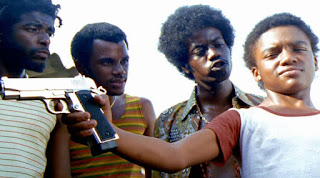
On Saturday 12 March at 5:31 the Phnom Penh Film Club treats itself to one of the most ambitious and influential Brazilian pictures of all time, Fernando Mierelles’ gritty and operatic 2002 chronicle of life in the favelas of Rio, *City of God*.  
.
Adapted by Braulio Mantovani from a novel of the same name by Paulo Lins, this near-incomparable picture manages to immerse its audience in the tales of so many disparate characters, so completely and so sympathetically, that the first time I saw it I had to put the disc back in the tray and check the runtime for myself: I literally couldn’t believe that I hadn’t just watched a three-hour and forty minute movie.
.
Alexandre Rodrigues is "Rocket," the undeniable protagonist in this dozen-character effort (all of whom are played, as is Mierelles’ custom, by people cast directly from the streets). Rocket’s dream of becoming a newspaper photographer forms the backbone of the picture, serving as the allegoric (if somewhat obvious) vehicle for the wider and more familiar narrative of little people who dream of escaping from the slums. As we follow Rocket through a childhood fraught with third-person violence, petty crime, desperate choices, unrequited love, and eventually a terror-stricken longshot gambit to a better life, our journey crosses paths all but incidentally with a veritable host of far shadier and far more comfortably underground figures.
.
By far the most shamelessly menacing (and by that measure charismatic) of Rocket's multitude of antagonists and would-be friends is “Li’l Ze,” a childhood companion whose preferred coping mechanism for the stranded choices before them is to commit a stunningly pointless spree of crimes—even by grown-up standards—thus setting himself on the path of becoming the favela’s most hardened and cheerfully homicidal drug dealer. 
.
Then there is “Carrot,” Li’l Ze’s counterpart, who wears his good-guy-of-the-neighborhood routine for as long as Li’l Ze will let him sustain the artifice by holding his own malevolence in check. Keeping the two of them separated is the self-appointed calling of “Benny,” an improbably gawky redhead who walks and talks and dresses like a bourgeois kid from the suburbs, but who manages just enough pot-smoked edge, at just the right moments and in just the right places, to assert himself as unlikely peacemaker and surprisingly fearless go-between for the rival bosses. All of this sordid intrigue unfolds while Rocket struggles to swallow his fear and his resentments long enough to catch the competing gangs in action for a life-changing scoop photograph.
.
In a lesson for all of us, Rocket checks his ego at the door of the newspaper in order to patiently, methodically cultivate relationships with the people he most wishes to emulate—fulfilling arrestingly mundane errands for them, right there on screen, while Carrot and Li’l Ze (and a third principal named “Knockout Ned”) are cheerfully trying every ugly trick that they can think of to settle short-term, ego-driven scores.
.
All is as we might expect so far, but it is the fourth and most complex act of this enormous film that elevates it beyond simple critical superlatives—cantilevering our deepest fears about poor Rocket and his innocent dream, while everyone around him corners themselves and each other in a web of escalating violence and more than occasional police complicity: People don’t make it out of the slum, we remind ourselves as we grip our chair arms with just that extra little bit of force: People *almost* make it out, and are thence dragged back across the threshold by the most basic monsters of our modern and dis-equal social orders. Surely this same predictable fate can’t be waiting around that last blind corner for our beloved hero—but just as surely no other, better fate will resonate with anything like the same believability. 
.
I hope everyone will plan to join us Saturday 12 March at 5:31pm for this riveting odyssey: of hope and revenge and love and loss and, ultimately, of the fickle angels of our best and most inspirational versions of ourselves. I can absolutely promise an evening well-spent and maybe even long-remembered. 

Click Here to Read More...

Saturday, January 22, 2022

Film Review: Travelers and Magicians (2003)

On Wednesday at 18:31 the Phnom Penh Film Club will savor the delightful and elegiac 2003 love-letter to the Kingdom of Bhutan, Khyentse Norbu’s *Travelers and Magicians*. 
.
One of the many things we lost when brick and mortar movie-rental stores went away, was their facility to serve as a de facto editorial vetting for the international film scene. In 2003, if you strolled into a Blockbuster- or Hollywood Video, and saw a “foreign” film available for rent, you couldn’t necessarily guarantee that it would be delightful (or even entertaining), but you could pretty-much guarantee that it would be significant in *some* way: Some international films would be importantly representative of the state of play in their home countries; some would be statement-pieces by a breakthrough director. Some would be terrific movies. 
.
And then, every once in a while, a film in this section of the store would turn out to be all of these things at once, like this one. 
.
Travelers and Magicians tells the twin tales of “Dondup”—a modern-day government official who dislikes his posting and dreams of emigrating to the United States—and “Tashi,” a restless farmboy who dislikes his magic classes so intensely that he flees into the woods, only to find himself drawn into an unsavory plot being orchestrated by a young woman in a joyless May-December marriage. 

Dondup, it transpires, has come into a once-in-a-lifetime opportunity to apply for a U.S. visa but, in just the first of a long series of complications, he misses the only bus to the capital city of Thimphu and is forced to hitchhike with a Buddhist monk, who spins him the parallel story of Tashi as a way to pass the time. As Dondup’s misadventures multiply, he and the monk are joined by an aging widower and his daughter, hoping to reach Thimphu in time to sell their home-made rice paper at an upcoming religious festival. 
.
Now a foursome, the party moves unhurriedly through the breathtaking Bhutanese countryside while the monk’s tale of Tashi and his unwilling enlistment in a sordid triangle of intrigue careens closer and closer to a moment of gripping tragedy. Will Dondup reach the capital in time to make his interview? Will Tashi’s story find its dénouement before the group must disband to its assorted fates? Has fortune already smiled on Dondup out there on that soaring yet companionable road, albeit in a fortune for which he hadn’t planned? 
.
In post-release interviews, writer-director Khyentse Norbu revealed that the Dondup story is an adaptation of a Japanese legend, while the Tashi story is a much more loyal adaptation of a traditional Bhutanese Buddhist folk tale. The seamless nesting of the stories is considered an essential aspect of Bhutanese storytelling, and none of the cast were professional actors. Indeed very few of them possessed the appropriate spoken language for their parts, and required extensive dialogue coaching before they could reliably recite their lines. 
.
I hope everyone will plan on joining us on Wednesday for this imminently delightful and breathtakingly gorgeous little gem of a movie. I can guarantee you a terrific night in the company of some of the best storytellers in Bhutan. All three of them.

Click Here to Read More...

Friday, January 21, 2022

Test Upload - Downfall Review

Sunday evening at 18:31 The Phnom Penh Film Club takes on Oliver Hirschbiegel’s weighty and divisive docu-drama *Downfall* (2004), starring Bruno Ganz as Adolph Hitler, careening through the waning days of the Second World War from the relative safety and near-total isolation of his bunker. 
.
By no small margin this is easily the most controversial picture we’ve considered since the group’s inception. Among many other deep and abiding objections voiced against this movie from the highest reaches of critical discourse, particularly strident umbrage has been taken with the notion of a “humanized” Hitler, specifically in the bitter throes of realizing that the war—and with it, his own survivability—are at an end. Comparatively “sympathetic” portrayals of the lower echelon of Hitler’s circle, and the moral complexity of basing the movie on the first-hand accounts of Hitler’s loyal surviving aides, have also been sharply and repeatedly upbraided in at least some circles of film criticism. During production the film set was repeatedly “visited” by Russian media, prompting more than one heated exchange and at least one incident of forced removal by security.     
.
Despite the incendiary divisiveness (or perhaps in part because of it) the film’s release and distribution were met with widespread commercial and critical acclaim. It was nominated for Best Foreign Film at the 77th Academy Awards, and has been lauded for its arresting depiction of the fall of the Third Reich by even some of the most stridently opposed historians and critics. Writing for The Guardian, acclaimed Hitler biographer Sir Ian Kershaw said the film had enormous emotive power, and went out of his way to question how anyone could view the coldly monstrous behaviour of Hitler and his inner circle in those last few days and find them at all sympathetic. “In real life,” said Director Hirschbiegel in 2015, “monsters do not walk around with claws for hands. Intelligent adults know that evil often comes packaged with a smile across its face.”
.
I hope everyone will plan to join us for this provocative, deeply challenging and discussion-worthy picture. Ganz’ performance alone is worth the effort—by far cinema’s best-ever portrayal of the most famous madman in history, a task too tall for all but the finest and most self-comfortable of acting talents. I can promise an unusually lively discussion when the credits for this one are finished with their roll. 

Click Here to Read More...

Wednesday, January 19, 2022

Michael Clayton Review -- test upload

On Saturday the Phnom Penh Film Club will view the smash-success directorial debut from career scriptwriter Tony Gilroy, *Michael Clayton* (2009), starring George Clooney, Tom Wilkinson, Sydney Pollack and Tilda Swinton. 

As described in the DVD commentary, Tony Gilroy's pitch for this masterpiece was as spartan as it was resonant with a young turk's confidence. "I want to tell a back-of-the-house story about a high-end law firm," he told the powers-that-be. "There will be no courtroom scenes, it will have a star part, and someone will die." 

That's it. That's all he told them.

...Probably if you or I had pitched that movie -- especially that way -- it would have enjoyed the kind of chances usually reserved for snowballs in very hot places. But experiential firepower matters in Hollywood (indeed at least as much as who you know), and where experience is concerned Mr Gilroy wasn't shooting blanks. This may have been his directorial debut, but his teeth were cut on writing for some pretty amazing pictures in their own right, as lead screenwriter for all three of the original Bourne Identity movies, and as writer-producer of the relentless albeit flawed movie about South American kidnap extraction, "Proof of Life." With Michael Clayton, then, Gilroy doesn't so much announce his arrival as prove that he belonged in the class of the "arrived" from the very beginning. 

George Clooney plays the title role: the resident "fixer" can keep the top-flight clients from bolting to another firm, taking all their more reputable business dealings with them. ("Never underestimate a motivated stripper, Henry.") Tom Wilkinson plays the senior litigator of the firm, and dogged defender of a shady agribusiness conglomerate with deep pockets and conspicuously shallower convictions.

The film opens with the booming voice of Wilkinson's character Arthur Edens, speaking in what sounds like affectionate, you-won't-believe-what-just-happened tones to his long-time colleague Michael. As he monologs unseen, the camera reveals a series of cutaways touring an apparently empty and darkened law firm in the middle of the night (though, on re-watch, our eyes are perhaps drawn to the shot of a ten-line office phone, on which eight of the lines are in use and the other two are on hold). "Okay," we think to ourselves, if only momentarily, "I get it: he's leaving someone a voice-mail." Except the longer Edens speaks, the more obvious it becomes that something is terribly amiss. ("...I realized I had been coated in this patina of shit for the best part of my life. The stench of it and the stain of it would in all likelihood take the rest of my life to undo. And you know what I did? I took a deep cleansing breath and I set that notion aside; I tabled it; I said to myself as clear as this may be, as potent a feeling as this is, as true a thing as I believe that I have witnessed today, it must wait....")

Edens, it transpires, suffers from a manic depression so enthralling that he occasionally misses its effects badly enough to skip his pills. After ten years of the agribusiness defense being all the life he has, Edens needs just the sort of holiday he knows he'll get by leaving the lids on his medicine bottles for a while -- prompting him eventually to strip naked in front of one of the plaintiffs at her own deposition. And when this happens, who else can the firm trust to rein-in their star attorney and soothe the rattled client, than their own in-house fixer Michael Clayton? And will Michael, confronted with a choice far more dramatic than any of the principals could ever have anticipated, do the right thing *or* the good thing, and for that matter will he even get the chance before his own shady dealings get the best of him? 

Executive producer Steven Soderbergh affixes his creative thumb-print all over this one, a film that might in a pinch be described as "Traffic Takes Manhattan," with all the same one-beat-out-of-rhythm unease, the same flaws in the characters' logic (and in their character), and the same sense that, if people don't get busy recognizing themselves for who they are pretty doggone soon, they're really going to regret it. Through the combination of Soderbergh and Clooney's executive oversight, with Gilroy's perfect-pitch on the subject of how to pace a suspense picture--stringing it tighter and tighter without snapping its plausibility in his hands--the film emerges as a best-of-three-worlds collaboration: at once uneasy and irresolute like Soderbergh, instantly sympathetic in that special way peculiar to Clooney, and absolutely gripping from the opening monolog all the way up to -- and through -- the end-titles, the device for which is at once the most simple and straightforward, and perhaps the most difficult to pull-off, of any I've yet seen.

On the insistence of Pollack and Soderbergh, Gilroy was given final-cut on this picture (something even he himself is on-record knowing well enough not to expect ever again), and his choices in the editing process reveal a sense of self, and a sense of medium, that even most of the great names in directing needed a lifetime to inhabit with such deft and underplayed aplomb. James Newton Howard's soundtrack outdoes even the best of his previous work, with haunting swells and fades juxtaposed against just enough low-rumble percussion to keep us planted squarely on the hook (the opening monolog is periodically stung with the muffled sound of someone striking the lowest half-dozen strings on a piano, through the opening between the lid and the case, instead of using the keys), and the set decorations are chosen with the kind of maestro care with which we can immerse ourselves totally into the competing worlds of a big and bustling midtown law firm, or a dingy basement poker match, without once feeling tugged around. In a particularly interesting wrinkle that also works -- flawlessly -- one of the very first scenes in the picture, and certainly the most tense and suspenseful in the first reel, is also one of the last scenes in the picture, meaning that at the end of the film we spend a thrilling car-ride sitting next to George Clooney, worried for him and all that he stands for in the movie, despite knowing exactly what's about to happen.

Literally all of the actors hit their marks impeccably -- thanks in no small measure to Casting Director Ellen Chenoweth: conservative and true-to-type where that will suit the movie (David Lansbury as Michael's alcoholic and no-account brother Timmy), but bold in precisely the right doses as to leave us, in the audience, feeling that extra undercurrent of tension that comes with a fine acting talent playing just a bit outside themselves. Most notable in this respect is the choice of Tilda Swinton, the always virtuoso actress (Vanilla Sky, Adaptation) who must somehow figure out how to play the in-house counsel for the client company, and do it in such a way as to come across equally cold-blooded and obviously in over her head ... and who of course pulls it off with skin-crawling deadpan.

I hope everyone will plan to join us Saturday for a film as cinematic as it is ambitious, as delicate as it is unstoppable. A film whose every character is sympathetic without always being likable, rendered with a maestro's flair for brushstrokes that are always beautiful while hardly ever being pretty. Few titles we've shared so far should be considered as universally can't-miss, and few are anything like as sure-fire bets to entertain.  
Click Here to Read More...

Friday, April 23, 2021

Remembering the Most Brilliant Stupid Show Ever to Air on TV


Thirty-nine years ago today, April 23, 1982, the CBS smash-hit WKRP in Cincinnati aired its series finale after four short years. And no, this isn't a post about movies. But it is a subject that hits near and dear to my heart so do please bear with me. 

When I was twelve years old, I knew exactly one thing about that silly tale of silly people working for a silly and so often star-crossed radio station in the anonymous midwest: I knew that it was the only thing on TV that was anything *like* this kind of funny. At age twelve, that was more than enough. 

Somewhere along the line I even convinced myself that my first paying job in life would be as a commercial, on-air radio disc jockey and, four short years after that last episode, so it came to be. As upside-down as that logic sounds, in hindsight it seems the least I could have done in tribute to one of my very favourite segments of television entertainment, ever, across my entire life. Hilarity wasn't the watchword for this show; it was the fail-safe minimum from week to week.

If you say "WKRP in Cincinnati" to  anyone in my demographic the odds are better than not that the reply to come back will be some variation on, "...As God is my witness, I thought turkeys could fly." As well it should be. Many, many of us will literally never forget where we were, and what we were doing, when we saw that episode. It was the funniest thing that had happened on television for years. 

But here's the thing, the sneak, the plot twist, the subtle brilliance of this devilishly subversive show: While you were too busy choke-laughing your way to apoplexy to notice, this scrappy, silly little program was also challenging everything you might have thought you could rely on about television and popular culture. From the very first episode, creator and head writer Hugh Wilson led an island of misfit-toy guerrilla writers (who, it was widely rumoured, closely mirrored the cast of characters at the station), on a ground-up demolition of cultural and broadcast norms, challenging everyone who watched while still keeping the show's wit sharp enough to con us into only vaguely even noticing that our morals and mores were being pulled apart right in front of us.  

The pilot threw this gauntlet down as effectively as any pilot of a television program ever would, even if most of us could barely pull ourselves together off the carpet long enough to notice. "Bailey, I'm calling a meeting this afternoon with Les and Herb," says the newly hired "Andy Travis" (Gary Sandy), Program Director and semi-willing XO of the clown patrol that is this station. "I want you to be there too."

And Bailey Quarters (Jan Smithers) blushes, adjusts her glasses, and says, "I've never been invited to a meeting before."

"Well," says Travis, simply -- and truthfully -- "that's been a mistake."
.
This was in 1978. The program we were all already scream-laughing at from over the tops of our Swanson TV-dinners had just casually and matter-of-factly challenged every last one of us on gender equity in the workplace, and it was 1978. A topic that you could reasonably expect to see addressed in a first-run program this very evening. 

From there, the Wilson writing team would only go on to just-as-effortlessly feint us into seriously reconsidering our retrogressive dogmas about racial justice, sexual harassment, Vietnam draft evasion, gay rights, substance abuse, poverty and crime, autumn-spring romance, impaired driving, animal welfare, unscrupulous concert promotion practices, bullying, Cold War self-determination, and inter-generational white privilege. Among rather a lot else. 

In one particularly poignant moment (from a typically hilarious episode, otherwise), staff receptionist Jennifer Marlowe (Loni Anderson) finds herself acerbically faking her way through a call-in advice program, when she discovers that one of her glib, off-the-cuff responses has just gotten a young woman badly beaten by her abusive husband and eventually hospitalized. Thence, over the span of about four minutes, a nondescript episode buried in the middle of their third season, wrote itself into confronting spousal abuse, sham-credentialing, employee crisis counseling, and the systemic -- one might rightfully say horrifying -- failures of the American mental health care infrastructure.

"You can't just shut yourself off, Jennifer," says station manager Arthur Calrson (Gordon Jump), in one of four emmy-nominated moments for him. Jennifer, fighting back tears, asks him why not. "Because I need you," says Carlson. 

"...I don't want people to need me," says Jennifer.

"Yes you do," says Carlson. "Yes you do."

A poignant moment, a dramatic confrontation of just one of the scary, basement dwelling foibles that our flawed and limping society throws up at us when we're least equipped to deal with them. Written so close to the bone that you can feel it underneath your skin. So clean, so distilled of flourish and bravado, so tight that you can reach up toward your screen and just about ping it with a finger. 

I would have said, "television doesn't get made like that anymore." It's a great writing device and I've pulled it from my bag of tricks a thousand times. But it doesn't apply. It's not that TV doesn't get made like that anymore, exactly; it's that, somewhere along the line, we forgot both the credit deserving of such pioneering bravery -- and the old fashioned need to couch our social comment, to consciously de-tune our "very special episodes," to ... gosh, I dunno, maybe entertain the audience with a welcomed laugh or two along the way. 
.
That's what doesn't get done anymore. Socially important television can be seen on any channel any time, day or night -- but rarely with the elan, and dash, and above all the wit, of shows like WKRP. It wasn't just hilarious; it was a riot in both senses.

We could sure use a show or two like that around here now. 
.
Dave O'Gorman
Phnom Penh, Cambodia
Click Here to Read More...